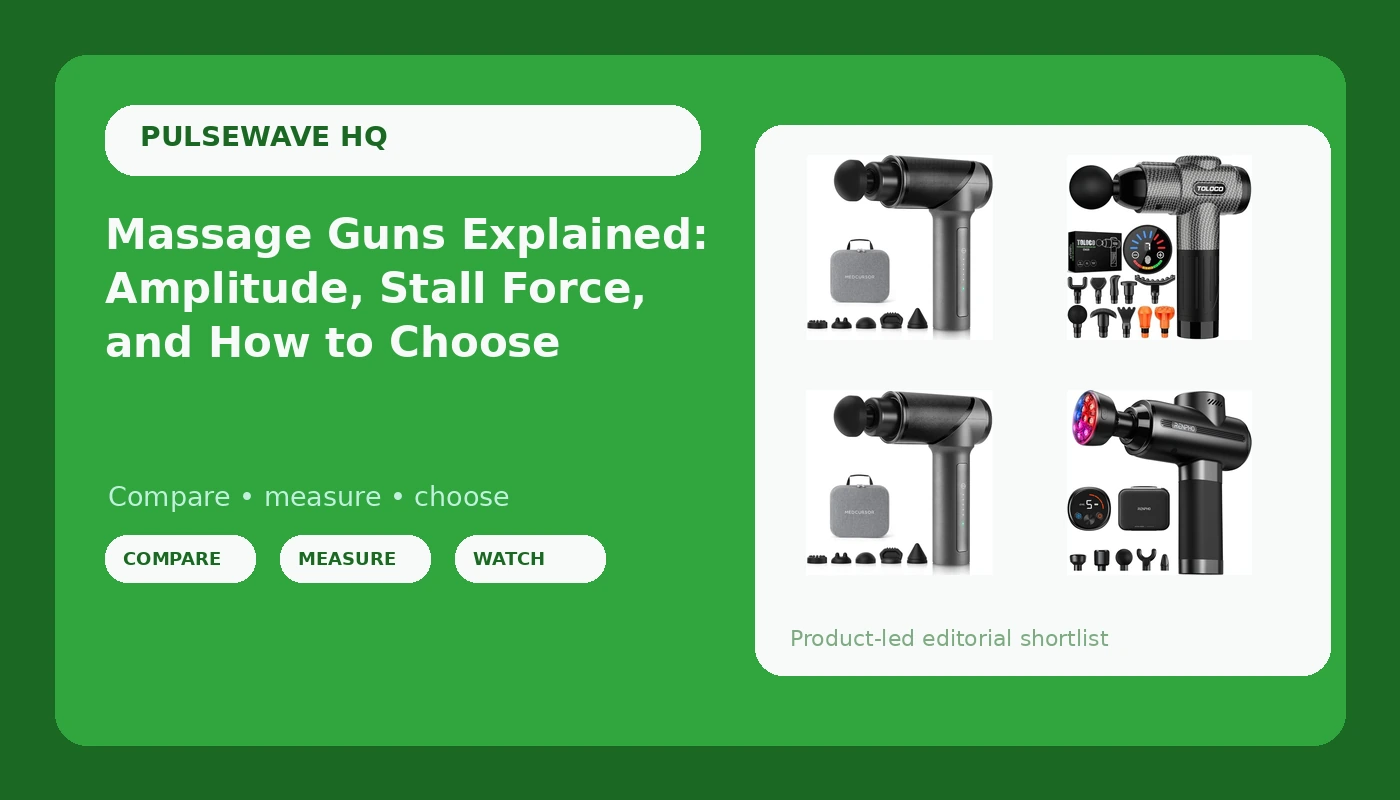
Percussion massage guns have landed in the same corner of the market as foam rollers and resistance bands: affordable enough to buy on impulse, and confusing enough that the numbers on the box point you in the wrong direction. Nearly every listing leads with strokes per minute, and RPM is the least useful figure printed there. What you actually feel in a tight quad the morning after a long ride comes down to amplitude, which is how far the head travels, and stall force, which is how much pressure the motor accepts before the stroke quits and the tool turns into a buzzer. This explainer covers both, then walks through four current percussion massage gun options and what separates them from each other.
Related: How to Use a Massage Gun on Sore Legs Without Overdoing It →
Quick answer
For most people, amplitude and stall force decide whether a gun is worth owning, and RPM barely registers. A motor that gives up the moment you lean into a stubborn muscle is not doing recovery work, no matter what the packaging claims. Among the four options covered here, the TOLOCO Massage Gun is the one with the widest head selection at ten interchangeable heads, the RENPHO Active Thermacool 2 Red is the only model in this group that adds infrared heating and a cool head, and the two Medcursor guns are the same six-head design offered in two finishes. None of these are medical devices, and none of them treat an injury.
Four useful options
| Model | Best fit | What stands out |
|---|---|---|
| TOLOCO Massage Gun, Carbon | Back and larger muscle groups | Ten interchangeable massage heads and a silent brushless motor |
| RENPHO Active Thermacool 2 Red Massage Gun | Warmup and cooldown routines | Infrared heating head plus a cool head |
| Medcursor Massage Gun (Black) | A straightforward cordless six-head tool | High intensity brushless motor with six massage heads |
| Medcursor Massage Gun (Gray) | Same design in a gray finish | Identical six-head setup, listed as a gift option |
Most head variety: TOLOCO Massage Gun
The trade off with a large head kit is decision fatigue. Most people end up using two heads for almost everything and leaving the rest in the case, which is fine, but it does mean you are paying for accessories you may never touch. If you already know you only work quads, calves, and upper back, head variety is a nice-to-have rather than a reason to buy.
Heat and cool heads: RENPHO Active Thermacool 2 Red Massage Gun
Temperature features are worth thinking through honestly. Heat before activity and cooling after are both common parts of a recovery routine, and having both in one handheld tool saves space in a gym bag. But if you already own a heating pad or you just want straight percussion, you are paying for a capability you will not use, and the heating element does not change the underlying question of amplitude and stall force.
A six-head cordless option: Medcursor Massage Gun (Black)
Six heads covers the standard range of shapes without asking you to sort through a dozen options, which suits anyone who wants to unbox the thing and get on with it. The limitation is the same one that applies to every gun in this group: the listing language tells you about the motor type and the head count, not about stroke length, so amplitude is the spec you still have to dig for.
Same tool, gray finish: Medcursor Massage Gun (Gray)
Because the two Medcursor entries share a model name, it is easy to end up comparing them as if they were different tools. They are not. Pick based on the finish you want and on which one is in stock, and do not expect the gray version to behave differently from the black one.
Prices and availability may change. Product images, names, and retailer links must be matched by verified ASIN. Do not state a current price, rating, stock status, or measured result without current evidence.
Amplitude and stall force, the two specs that matter
Amplitude is stroke length in millimeters, and it describes how far the head travels on each pulse. That travel is what turns a tapping sensation into something that reaches deeper tissue. A gun in the 10mm range feels light and surface level. Once you get into the 14mm to 16mm territory, you are in what most people would call deep tissue percussion, and you can feel the difference through a thick quad or a tight calf. Amplitude is also the number brands most often leave off the listing, which tells you something about how much they want you comparing on it.
Stall force is the other half of the equation, and it is the one that separates a real recovery tool from a novelty. Push a gun into a muscle and the motor has to keep driving the head forward against that resistance. When it cannot, the stroke stops and all you get is vibration against the skin. That is a stall. Cheap guns stall early, and the experience is unmistakable: you press down on a hamstring and the thump disappears. Since most listings do not publish a stall force figure, the practical workaround is reading reviews for descriptions of what happens under pressure, and being skeptical of any box that says "therapy grade" without a number attached.
RPM deserves a short note because it dominates the marketing. Strokes per minute tells you how fast the head cycles, and a fast head with a short stroke just taps quickly. Without amplitude behind it, a big RPM number is a rounding error in how the gun actually feels.
How to judge a gun before you buy it
- Find the amplitude figure if it is published anywhere. If a listing never mentions stroke length, treat that as a missing spec rather than an oversight.
- Look for any indication of how the motor behaves under load, either a stall force number or reviews that describe pressing the gun into a tight muscle.
- Check noise levels at the speeds people actually use, not the lowest setting. A gun you avoid turning on because it is too loud is a waste of money.
- Match the head selection to the areas you really work. Ten heads is only useful if you rotate through more than two of them.
- Decide whether extras like infrared heating or a cool head belong in your routine before you pay for them, not after.
Practical guidance
- Work muscle bellies only. Never bone, joints, or the spine. That is anatomy, not a legal disclaimer.
- Keep it brief per area, roughly a minute or so of slow passes, then move on to the next muscle group.
- Use a gun for warmup and recovery, not as treatment. It helps blood move through tissue; it does not fix an injury.
- Start at the lowest speed and increase only if the gun is holding its stroke. If the thump fades, back off rather than pressing harder.
- If you have an injury, a diagnosed condition, or pain that persists, talk to a clinician before adding percussion to your routine.
Which option should you choose?
Choose the TOLOCO Massage Gun when you want the widest head selection and you plan to work a range of areas from the upper back down through the legs. Choose the RENPHO Active Thermacool 2 Red Massage Gun when heat before a session and cooling afterward are part of how you already recover, and you would rather carry one tool than three. Choose the Medcursor Massage Gun (Black) when you want a simple six-head cordless percussion gun without temperature features. Choose the Medcursor Massage Gun (Gray) when you want that same six-head design in a gray finish, or when you are buying it as a gift.
One caveat applies to all four. The available product information describes motor type, head count, and in one case temperature features. It does not tell you amplitude or stall force, which are the two numbers that most reliably predict whether a gun will hold up under your hands. That is an argument for buying from a listing you can return, and for testing the gun on your own quads and calves before you rely on it during a training block.
The bottom line
A massage gun is a recovery and warmup tool, and the useful ones share two traits: enough stroke length to reach past the surface, and a motor that keeps driving when you press. RPM charts and "therapy grade" stickers do not tell you either. Of the options here, the TOLOCO covers the most ground with its ten heads, the RENPHO Active Thermacool 2 Red is the only one that brings heat and cooling into the same device, and the two Medcursor guns are a straightforward six-head cordless choice in black or gray. Any of them can earn a place in a recovery routine. None of them replaces sleep, hydration, and a clinician's advice when something actually hurts.